I struggled with this message because I know there is so many people (including myself) struggling in our world today. It’s funny because as I was preparing this word of encouragement at 3AM this morning Ephesians 3:20 popped in my mind, but due to uncertainty I went back to bed to marinate on it a little more. When I woke back up to continue writing this word of encouragement that same scripture popped back up.
My brothers and sisters, take a look at what Ephesians 3:20-21 reminds us in the midst of our struggles; ”Now unto Him who is able to do far more abundantly than all that we ask or think, according to the power at work within us, to Him be glory in the church and in Christ Jesus throughout all generations, forever and ever. Amen.”
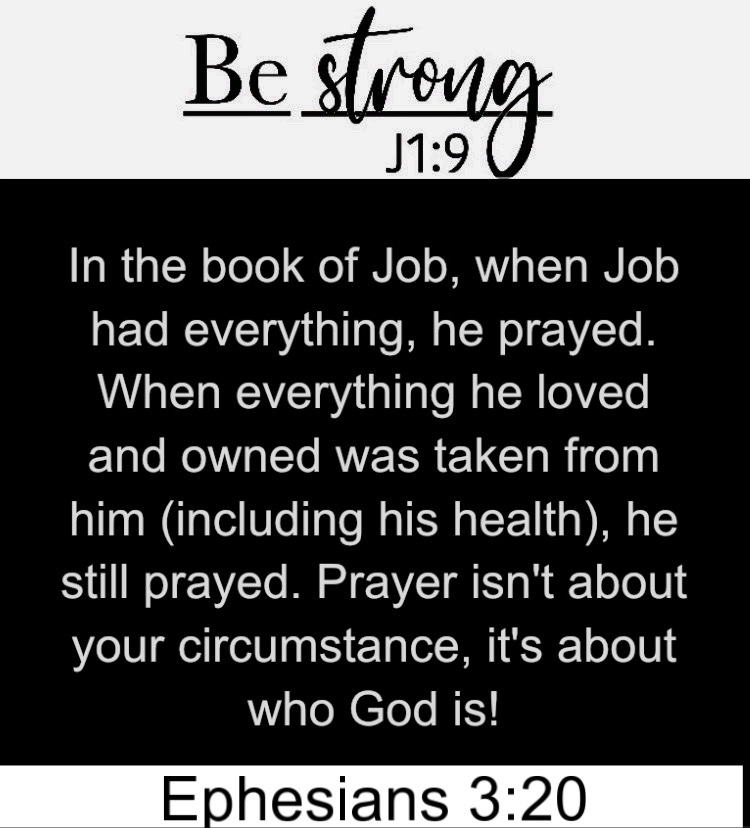
In the book of Job, when Job had everything, he prayed. When everything he loved and owned was taken from him (including his health), he still prayed. Prayer isn’t about your circumstance, it’s about who God is!
If He did it for Job and everyone else throughout scripture, He will do it for you and me! All we have to do is give him the glory, praise, honor, and worship that He rightfully deserves in advance. Our plight, situation, or circumstance doesn’t call God into action; it is our faith in prayer that moves Him!
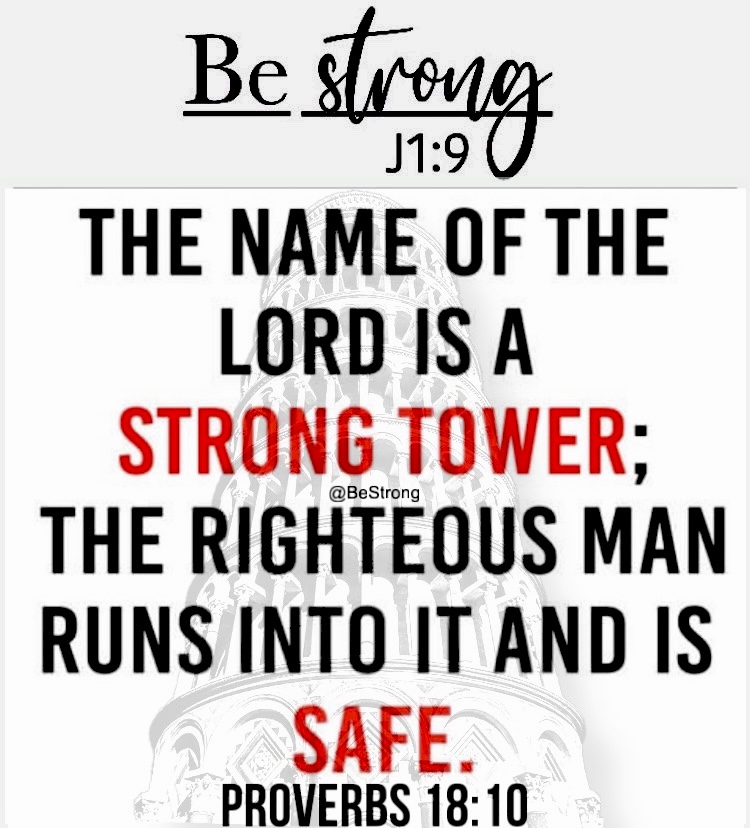
In seasons of overwhelming uncertainty, there is an encouraging promise given by God to every believer. Proverbs 18:10 says, “The name of the Lord is a strong tower: the righteous man run into it and is safe.” This verse is short and simple, but the promise is profoundly powerful.
So, the million dollar question is where do you run to when life knocks you down?
The reality is we do have a choice. They’re many different places we can look to find temporary peace and protection, but it’s only temporal. Let’s be honest, some of us including me have sought protection from our worldly hurts by running into temporary ‘shelters’ only to find that every source of worldly protection developed and promoted by man will ultimately fail us in the day of untimely or unwanted adversity, trouble, and pain.
Psalm 124:8 says, “Our help is in the name of the Lord, who made heaven and earth.” Psalm 18:2-3 describes the strength that is found in God. “The Lord is my rock, and my fortress, and my deliverer; my God, my strength, in whom I will trust; my buckler, and the horn of my salvation, and my high tower. I will call upon the LORD, who is worthy to be praised: so shall I be saved from mine enemies.”
I could go on, but I’m going to stop right here….
If this message is speaking to your situation I want you to remember that you are not alone. We are all susceptible to life’s unexpected blows and woes. However, I want to remind you that God’s strong tower is always opened for your refuge, recovery, restoration, and rest. Never forget the world makes many promises, but it will always leave you empty and hopeless in the end.
Let me close with the Amplified Version Classic Edition’s rendering of this powerful verse: “The name of the Lord is a strong tower; the [consistently] righteous man [upright and in right standing with God] runs into it and is safe, high [above evil] and strong.” This is the proper Christian posture for the child of God. My brothers and sisters, run to God today, be encouraged, and be strong; He has you covered and He will always have your back!
I love the way Colossians 3:13 is translated in the NLT and it reads, “Make allowance for each other’s faults, and forgive anyone who offends you. Remember, the Lord forgave you, so you must forgive others.” In lieu of ‘make allowance’ other translations used the terms or phrases ‘bear with ’, ‘be tolerant’, ‘put up with’, and ‘forbearing’. I personal think to ‘make allowance’ is the most effective term to use because it properly captures the spirit of what Paul was telling the church at Colossae.
Here’s a little trivia about this translation; the NLT was created by a team of 90 top Hebrew and Greek scholars working with texts in the original languages. It was published in 1996 and the general purpose for the translation was to make the Bible understandable and accessible to all readers.
Now let’s get back to the text…
The Colossians, like most people today struggle with true forgiveness. You see, when we make allowances for people to act stupid what we are really doing is setting a realistic expectation for ourselves. In other words, we insulate our hearts from the adverse effects of harboring anger and resentment because we know at some point we too will eventually need that same allowance….if not more.
Jesus taught His disciples to forgive others in the same way God had forgiven them. Unfortunately, some Christians believe in the concept of forgive them and then banished them. Which is the polar opposite from the way God in Christ forgives us. God chooses to forgive us and then reconciles us back unto fellowship (1 John 1:9).
Look at it this way, God made allowances for every sin known and unknown to man and He crushed them on the cross on Calvary’s Hill. Paul said in Romans 5:8, “But God showed His great love for us by sending Christ to die for us while we were still sinners.”
Paul knew that if the church was going to learn how to forgive like God forgives they must first, “be clothed with tenderhearted mercy, kindness, humility, gentleness, and patience” (Colossians 3:12).
I briefly reviewed the *Barna study and it said, “Most Christians recall a point at which they gave no-strings-attached forgiveness, some express reluctance in specific cases. Around one in four practicing Christians (23%) has a person in their life who “they just can’t forgive.” This study also found that theologically, those who can’t forgive someone are more likely to say people go to heaven because of good deeds (39% to 21%). Practically, they are less likely to believe mercy influences their words or actions (46% to 67%). Among those that took survey 87% of the respondents that received forgiveness said they have given it in return, compared to 64% of those who said they have not received unconditional forgiveness.
In closing, forgiveness is not an option it’s a command. It’s a command because in Christ Jesus God made allowances for every sin known and unknown to man. Therefore, if you have incarcerated people in your prison of unforgiviness and/or partial unforgivness, it behooves you to exonerate and pardon them immediately because by not doing so you jeopardize your own forgiveness with God. Jesus said in Matthew 6:15, “But if you refuse to forgive others, your Father will not forgive your sins.”
This study is based on quantitative surveys of 1,007 U.S. adults, 1,502 U.S. practicing Christian adults and 600 U.S. senior pastors of Protestant churches.
Many of you know that my father is a renowned and now ‘semi-retired’ auto mechanic. As a child, watching him pull engines and then reinstall them would literally blow my mind away. One of the reasons his diverse automotive skill-sets are so profound is because he was self-taught or should I say ‘God-taught’.
I vividly remember watching him restore three vintage ford Mustangs, but the one that is most memorable to me was the red 66 model. A classic indeed, but before it was restored, it looked like a broke down bucket of bolts. The interior and exterior had better days to say the least. Dad kept her in a separate portion of his auto-mechanic shop and each day he would repair and/or restore a section of that ‘Stang’ until all of the broken parts were made new again. It took him a little while to get it all dolled up, but eventually he rehab that vehicle like it was brand new with all original parts.
Let me lift this up for you! Many of you know our Father who art in heaven and He is the renowned Creator and Restorer of the universe. He restores lost time, bestows new identities, creates new life, and make broke things new again! Revelation 21:5 says this, “And the One sitting on the throne said, “Look, I am making everything new!” And then He said to me, “Write this down, for what I tell you is trustworthy and true.”
My dad didn’t restore those vehicles overnight…it took time. In that same vein, in time God is able to make broke down things become new again. He alone has the power to make all things new, and He demonstrated that to us when He raised Jesus from the grave. My beloved brothers and sisters, God is in the business of restoration and resurrection. His Kingdom will come one day — Satan will be overthrown — but renewal, refreshment, revival, reconciliation, and restoration is also happening now on a smaller scale.
The devil won’t bother you while you’re living in sin, but he’ll bother you when you’re trying to get out.
Breaking free (aka) getting out from sin generally involves a conscious effort to recognize and resist temptation, as well as a commitment to live according to the word of God. It requires hunility, self-reflection, self-discipline, and support from others fellow believers (James 5:16).
Breaking free from sin involves confessing our sins to God (1 John 1:9), seeking forgiveness (1 Chronicles 7:14), and relying on the guidance of the Holy Spirit (Romans 8:14) to resist temptation (James 4:7) and live a purposed driven life (Jeremiah 29:13).
Breaking free from sin requires a willingness to examine one’s thoughts and actions, identify areas where improvement is needed, and taking the appropriate steps towards positive change. It may also involve seeking guidance from spiritual leaders, participating in support groups, or engaging in practices such as prayer or self-reflection. Ultimately, breaking free from sin is a personal journey that requires God’s help, commitment, perseverance, and a willingness to grow and change. Paul reminded us in Roman’s 12:2 to live a transformed life in Christ. The NLT put it this way, “Don’t copy the behavior and customs of this world, but let God transform you into a new person by changing the way you think. Then you will learn to know God’s will for you, which is good and pleasing and perfect.”
If you want to break free today the first step is to open your heart and mouth and humbly approach God’s throne room of grace and tell Him what He already knows about you!
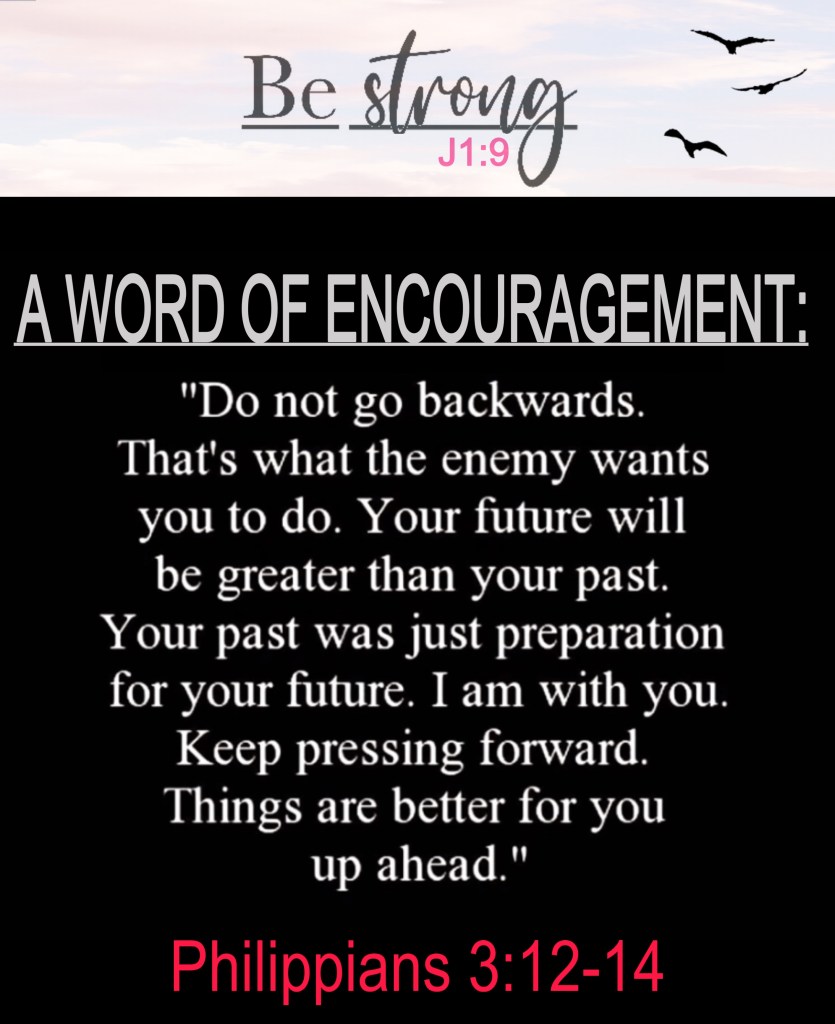
Our brother Paul said in Philippians 3:12-14, “I don’t mean to say that I have already achieved these things or that I have already reached perfection. But I press on to possess that perfection for which Christ Jesus first possessed me. No, dear brothers and sisters, I have not achieved it,d but I focus on this one thing: Forgetting the past and looking forward to what lies ahead, I press on to reach the end of the race and receive the heavenly prize for which God, through Christ Jesus, is calling us.”
When Paul said he was “forgetting those things which are behind,” he referred to not looking back at past relationships, memories, failures, temptations, or anything that might distract from a single-minded focus on “the upward call of God in Christ.” To inspire his audience, Paul drew on the image of an athlete running a race with uncompromising determination to reach the finish line and win the prize. The New Living Translation renders the passage like this: “I focus on this one thing: Forgetting the past and looking forward to what lies ahead, I press on to reach the end of the race and receive the heavenly prize for which God, through Christ Jesus, is calling us.”
“Forgetting what is behind” is Paul’s way of saying, “Don’t look back! Stop dwelling on the past. Don’t let anything behind you interfere with your present progress or future efforts.” Personal growth as a believer was a constant priority in Paul’s life. He strained with every fiber of his being to keep moving forward to win the prize for which God had called him.
That said, I don’t know who this word of encouragement is speaking to today, but if that’s you let me remind you that holding onto emotions like bitterness and unforgiveness can slow you down and even keep you locked in the past. Rehearsing conflicts and rehashing hurtful episodes will only open old wounds. Our brother Peter urged us to be done with these things: “So get rid of all evil behavior. Be done with all deceit, hypocrisy, jealousy, and all unkind speech. Like newborn babies, you must crave pure spiritual milk so that you will grow into a full experience of salvation. Cry out for this nourishment” (1 Peter 2:1–2, NLT).
At the end of the day, the Christian life is lived with our eyes facing forward on Jesus Christ. He is the ultimate priority that makes our lives worth living. Our highest goal is to know Him better, as Paul said: “I want to know Christ—yes, to know the power of his resurrection and participation in His sufferings, becoming like Him in His death” (Philippians 3:10).








 4GIVEN