Praise is something that wants to be EXPRESSED. Praise isn’t satisfied to think on the worth of something. Praise wants to sing of it, tell of it, and tell others about it.
The word “worship” is sometimes a quiet reverance…bowing down to something infinitely great. And sometimes bowing down is silent.
But praise is different. Praise can’t really be silent and still be praise. In one of the most effusive or heartfelt displays of praise recorded in the Bible, when all of Israel was bring up the Ark King David danced “before the Lord with all his might” (2 Samuel 6:14). You see, praise is expressing the greatness and beauty and excellence of something. When we’re praising God, we are expressing His vast greatness, incomparable beauty, and empirical excellence.
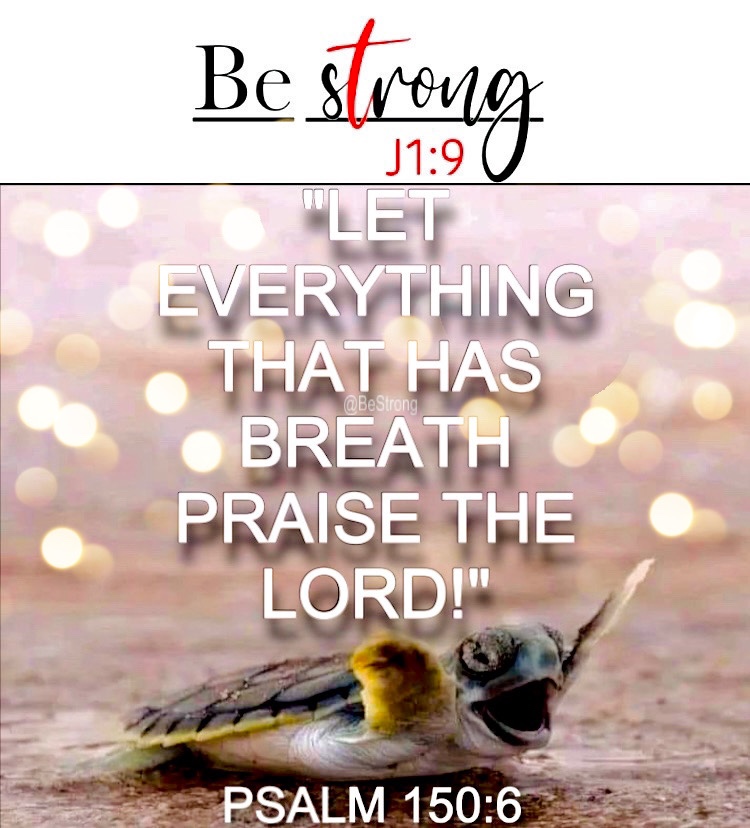
David reminds us in Psalm 150:6, “Let everything that has breath praise the Lord!” The Psalmist is calling us to express the excellence, the beauty, and the greatness of the true God and no one else. Additionally, the burden of this Psalm isn’t hard to discern or understand: “Praise the LORD!” The Hebrew here is hallelu-jah. It is two words: “hallelu” and then “yah.” “Hallelu” is a command. It is saying, “Praise!” And then “yah” is short for “YHWH.” The Psalmist is saying, “Praise YHWH!” “Praise the LORD!”
If your still reading devotional I invite you to consider that Pslam 150 comes after 149 Psalm(s) that have reflected on God’s ways, the trials that life brings, and the miracles He has accomplished. Therefore, don’t praise Him with naïve and reckless passions. But with the deep passion of someone who knows the God they’re praising. You know even more that God remains the most glorious being there is. There will never ever be is anyone above Him, anyone before Him, anyone after Him, and anyone greater than Him.
Above all, and above all things, if you have breath….”Praise the Lord!”
2 Corinthians 12:9, reminds us that God’s grace is sufficient and that His power is perfected in our weaknesses. This may sound like an oxymoron but it’s true! I invite you to look at it this way, God literally reaches down in our weakness and picks us up! He provides the strength we need to make it through our struggles. He doesn’t always take them away, but He always carries us through!
The words made perfect in 2 Corinthians 12:9 mean “fully or entirely accomplished or made complete.” Christ’s power is made complete—it is able to fully accomplish its purpose—when His people are weak and depend on Him for strength. When we, like Paul, stop resisting and complaining and let the power of Christ rest on us, we make room to receive countless unexpected blessings from the Lord. By allowing God’s strength to be made perfect in our weakness, we have the opportunity to display God’s glory flawlessly.
The Bible gives several examples of God’s strength manifesting when His people are weak. Moses, the great leader of Israel, was deeply aware of his human shortcomings (Exodus 4:10). When the Lord called him to go to Pharaoh, Moses cried, “I’m not adequate. Please send someone else!” But God replied, “Go anyway, Moses, because I will be with you” (see Exodus 4:12–15).
I Corinthians 1:27 teaches, “But God chose the foolish things of the world to shame the wise; God chose the weak things of the world to shame the strong.” We must never shrink away from God because of our weakness but run to Him, letting Him equip, encourage, empower, and inspire us to accomplish His will. We must remember His promise: “He gives strength to the weary and increases the power of the weak. Even youths grow tired and weary, and young men stumble and fall; but those who hope in the LORD will renew their strength. They will soar on wings like eagles; they will run and not grow weary, they will walk and not be faint” (Isaiah 40:29–31).
At the end of the day, God’s great power and sufficiency will always rest on us as we find our strength in Him, and He is glorified. We can whole honestly say with the psalmist, “My flesh and my heart may fail, but God is the strength of my heart and my portion forever” (Psalm 73:26).
Father God, thank You for showing me Your unfailing love! When I grow weary or become disappointed, it’s Your love that motivates me not to quit and to keep going. I am so ever grateful that Your love endures forever! Nothing can separate me from You or keep me from Your presence. Thank You for drawing near to me through this time, and thank You for what You’re going to do next. In Jesus’ name, Amen.
In the book John chapter 11, we read about Lazarus, who was deathly ill, and how Jesus apparently delayed His journey to reach his beloved friend.
John 11:5-6 says, “Now Jesus loved Martha and her sister and Lazarus. So when He heard that Lazarus was sick, he stayed where he was two more days.”
Inevitably, Lazarus dies, and when Jesus finally arrives, those around Him raise a deep question:
But some of them said, “Could not He who opened the eyes of the blind man have kept this man from dying?” (John 11:37).
Certainly, these people had previously witnessed Jesus’ miracles, but the tomb that was before them created questions about God’s plan for His friend Lazarus. If we are honest with ourselves, how many times have we felt the same, that God does not answer us or that He has delayed in coming to help us?
Waiting on God is not only difficult; sometimes it seems impossible. I’ll be the first to submit to you that in the meantimes and in between times I struggle with waiting on God to take action.
Let’s be honest, we all want things to happen in our own timing, according to our plans. However, God doesn’t operate on our schedules, and expecting that He will sets one up for disappointment.
Mary, Martha, and the host of onlookers discovered that God’s timing was impeccable when Lazarus walked out of that tomb. For those who didn’t know, the Lazarus story was a precursor to Jesus’ story in terms of His death, burial, abd resurrection.
Patiently waiting on God is not for the faint at heart, but One divine attribute that will enable us to patiently wait on God is His sovereignty. We can have complete confidence in His total, independent control over every creature, event, and circumstance at every moment in history. Subject to none, influenced by none, and absolutely independent, God does what He pleases, only as He pleases, and always as He pleases. Nothing can stay His hand: “I make known the end from the beginning, from ancient times, what is still to come. I say: My purpose will stand, and I will do all that I please” (Isaiah 46:10). Once we better understand God’s sovereignty, coupled with His goodness, waiting for God to act becomes a matter of a child trusting in his father’s faithfulness, sure of his father’s strength. Don’t wait on God, rather wait in God; in His strength, in His timing, in His assurance, and in His peace!!
Today, we reflect, remember, and honor those who selflessly died sacrificing their lives for our freedom. When many of us ran for protection, these men (He-roes) and women (She-roes) ran into the fire! Our flag does not fly because the wind moves it. It flies with the last breath of each soldier who died defending and protecting what the flag represents; it’s people. What cost us nothing cost these brave men and women everything. Jesus said this in John 15:13, “Greater love hath no man than this, that a man lay down his life for his friends.”
My brothers and sisters, Memorial Day is not a celebration, rather it is a solemn contemplation over the cost of our freedom. I pray that every American across our great nation will take a few minutes (out of the next 12 waking hours) to reflect on the importance of freedom and the value of the sacrifices made by those who died defending it. Though we may not know them all, we certainly owe them all!
To wait on the Lord simply means to stand firm on what God has already spoken to you. To wait on God’s answer, voice, or promise in prayer is an essential part of our earthly walk with God.
However, for many, the deepest pain of waiting on the God lies in the sense that God, who once seemed so near, now feels so far away. Oftentimes we may find ourselves saying with David, “How long, O Lord? Will you forget me forever? How long will you hide your face from me?” (Psalm 13:1). The heavens were once a window; now they seem more like a wall.
Remarkably, Israel’s psalmists and prophets did not take God’s felt absence as reason to doubt and turn away from Him. In their waiting, they kept a fundamentally God-upward posture: their knees bent and their prayers and eyes lifted to the God they could not see. The minor prophet said this in Micah 7:7, “As for me, I will look to the Lord; I will wait for the God of my salvation; my God will hear me.”
So what do you do in the proverbial wait?? Well, the short answer is to faithfully look forward to God’s promises to manifest. With God’s past faithfulness fresh in our minds, we can dare to the look toward the future with hope. We can take our stand like a watchman on the walls, and say with unshakable faith, “I wait for the Lord, my soul waits, and in his word I hope” (Psalm 130:5). God’s promise now no longer seems like an empty word, a fragile wish: it will come as surely as the dawn (Psalm 130:6).
My brothers and sisters, God is not just found in our blessings, answered prayers, and miracles. God is also found in the waiting. He’s in our moments of silence. He’s in the seeking, asking, and surrendering. He’s also in the hard and in between times. Even if we don’t see or feel it, the Lord is with us and He will never leave us nor forsake us (Deut 31:6) and He will never change.